
Public Art Resources FAQ’s
Here are some initial resources. Click on the titles for more information.
ULI TB Art In Place
Highlights of ULI Tampa Bay’s Art In Place activities and shows how even individual property owners and small developers can boost demand and identity for their buildings through arts uses—like pop‑ups, galleries, or cultural programming—that increase dwell time and street-level vibrancy.
How Artists Drive Real Estate and Economic Growth – Tampa Arts Alliance
A conversation with Michele Smith, President and CEO of the Tampa Arts Alliance, shows how investing in arts infrastructure, public art, and affordable artist housing drives real estate value, walkability, and talent retention in Tampa’s urban core.
Quick Reference table of local policy and ordinances:
– Tampa & Hillsborough areas
– Pinellas County
Public Arts Alliance
The Public Art Alliance is a 501 (c) 3 nonprofit organization that supports the City of Tampa in realizing Public Art projects.
Westshore District Public Art Map
This map showcases artists who are expressing the culture, history, and beauty of Westshore Tampa is eyecatching, murals and large-format artwork for all the public to enjoy.
Tampa Arts
EVERYTHING you want to know about How, Who, What, Where and lesson plans on what already is and much much more!
Happy Cities – “The Business Case for Placemaking”
Synthesizes evidence that placemaking boosts local economies, supports resilient main streets, and helps small businesses thrive, with accessible language for business audiences.
Fourth Economy Consulting – “The ROI of Placemaking”
Summarizes measurable impacts such as increased land value, tourism, business starts, and a Toronto study showing large increases in time spent, positive feelings, and word‑of‑mouth for places with public art and placemaking elements.
TurningArt – “Strategic Placemaking: How Public Art Builds Value and Identity”
Developer‑oriented article on public art as a branding and economic tool, referencing CBRE and Americans for the Arts on how integrated art programs support leasing, property values, and community loyalty.
ULI Los Angeles – “Public Art as an Asset within Development Projects”
Short piece outlining how to treat public art as an asset on a pro forma, including using foot‑traffic metrics and early integration with architecture/landscape to realize ROI.
NOW Art – “Public Art as an Asset within Development Projects: The Value Proposition”
Focuses on public art as a long‑term value driver when coordinated with design from the outset, with language developers can relate to about returns and benchmarking impact.
RIOS – “The ROI of RIOS’ Value‑Driven Placemaking”
Firm‑side case discussion of how value‑driven placemaking translates into higher retail occupancy and measurable economic impact, helpful as a private‑sector example.
National Endowment for the Arts – “Creative Placemaking” report
Landmark paper detailing how arts and culture contribute to local economic development, livability, and cultural placekeeping, with frameworks and case examples you can quote with civic leaders.
Urban Land Institute – “Creative Placemaking: Sparking Development with Arts and Culture”
ULI’s report for real estate audiences on how leveraging arts and culture can de‑risk projects, revitalize neighborhoods, and support branding and leasing.
Americans for the Arts – Arts & Economic Prosperity (AEP) studies
National series showing that arts spending can generate roughly a 7:1 return in local economic activity, plus strong data on visitor spending and jobs.
National League of Cities – “Reimagining Public Space through Creative and Equitable Placemaking”
Explains placemaking as a municipal strategy, including how projects can bridge racial and socioeconomic gaps while generating social and economic benefits.
We hope you find these to be useful.
How do I calculate a public art in‑lieu fee?
Short Answer
Most cities use a simple formula: In-lieu fee = required percentage × eligible project cost, subject to any cap. Eligible cost is usually your construction cost or permit valuation, not including land, but definitions vary by city.
Key Steps
- Check your city’s percentage. For example, Tampa’s in-lieu option in Center City/Channel District is 0.5% of total development cost (with a 200,000-dollar cap); Dunedin uses 0.5% of Project Cost, and Clearwater uses 0.75% of Aggregate Job Value for in-lieu, with caps. Always confirm the current numbers in the ordinance or with staff.
- Confirm what “project cost” means locally. Some jurisdictions use permit valuation or Aggregate Job Value; others specify “total development cost” or hard costs only. Ask staff or your land-use attorney to confirm in writing.
- Do the math and apply the cap. Multiply the eligible cost by the required percentage. If the result is higher than the city’s maximum contribution, the cap controls; if lower, the calculated number stands.
- Get written confirmation from the city. Before finalizing your pro forma, request a simple email or memo from staff confirming the amount, timing, and any account details for payment.
Tip
Create a small internal calculator (spreadsheet or app) with fields for city, % required, cap, and project cost so your team can run scenarios quickly when comparing sites.
What counts as public art for my project?
Short Answer
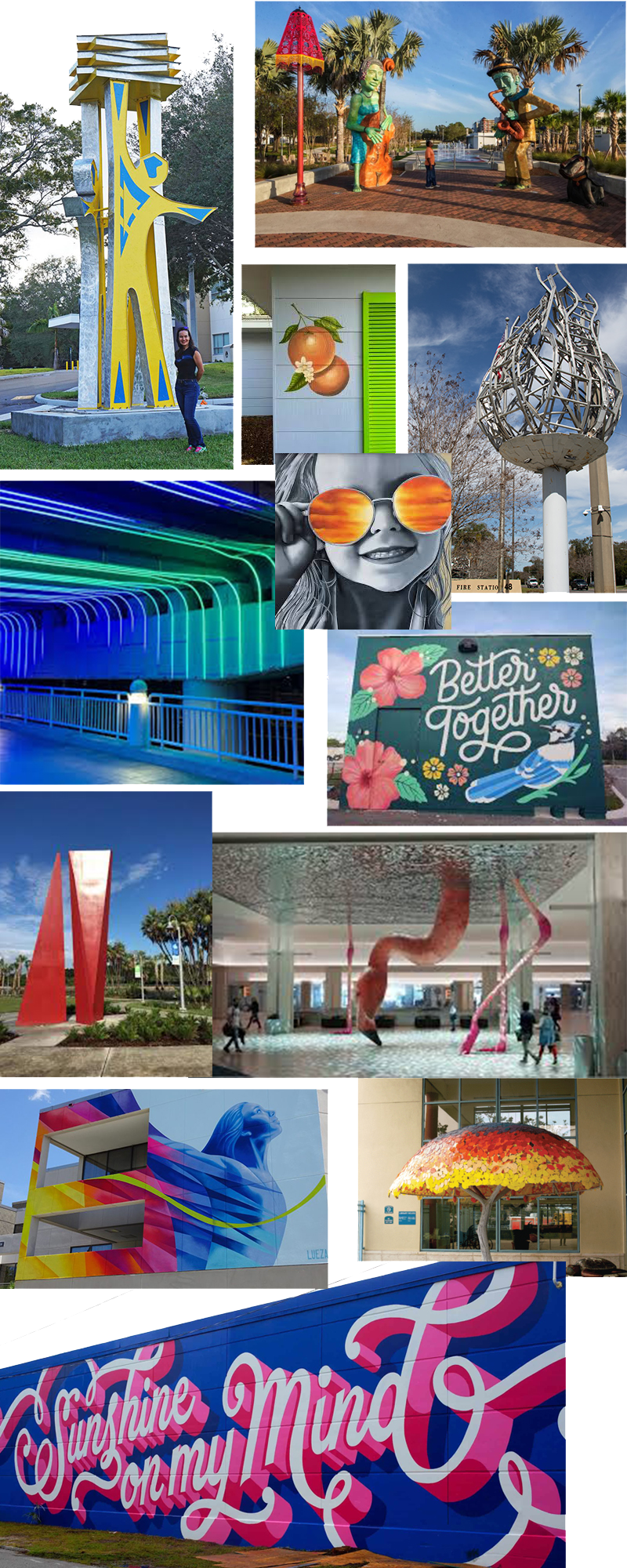
Public art generally means original work by a professional artist that is visible and accessible to the public, designed for long-term installation and integrated with the site.
Typical Eligible Types
- Free-standing sculpture, integrated architectural elements, or reliefs.
- Murals, mosaics, glass, lighting, or digital works visible from the public realm.
- Artist-designed streetscape, landscape, seating, or water features that are functionally part of the project.
Common Requirements
- The work must be created or led by a professional artist, not a generic catalog object.
- It must be durable, safe, and maintainable for many years in the local climate.
- It should be accessible to the public (street, plaza, lobby with free access, or similar spaces).
Tip
Always check your city’s specific examples and exclusions; some locations do not count general landscaping, standard signage, or off-the-shelf décor toward the public art requirement.
When in the development process should I plan for public art?
Short Answer
Plan for public art as early as you plan your site layout and amenity strategy—ideally during initial concept and entitlement—so it supports leasing and design instead of becoming a late-stage add-on.
Best Timing
- Site selection / pro forma. Flag whether your site is in a jurisdiction with a public art requirement and reserve 0.5–1% of construction costs in your budget as a placeholder.
- Entitlement and pre-application meetings. Tell staff upfront that you intend to meet public art requirements (or voluntarily provide art) so it can be integrated into public benefits, open space, or design review discussions.
- Design development. Coordinate with your architect, landscape designer, and, ideally, an art consultant so the artwork has a defined place in the plan and the necessary structural and electrical support.
- Permitting / near construction. Finalize any required public art submittals and in-lieu calculations; secure approvals and schedule payments or installation relative to permits and certificate of occupancy.
Tip
Early planning usually costs less over time, prevents redesign, and lets you use public art strategically for placemaking, branding, and community support in hearings.
How do I decide between on‑site art and an in‑lieu fee?
Short Answer
Choose on-site art when you want strong place identity and leasing value at your project; choose in-lieu when you prefer administrative simplicity and are comfortable with the city placing the art elsewhere in the district.
On-Site Art – Pros
- Directly enhances your project’s curb appeal, wayfinding, and brand.
- Can support higher rents, absorption, and community goodwill when done well.
- Gives you design control (within city guidelines) over how art fits into the site.
On-Site Art – Cons
- More coordination with design, construction, and maintenance.
- Long-term responsibility for upkeep and repairs.
In-Lieu Fee – Pros
- Simpler to administer; you write one check and the city manages the art project.
- Predictable cost if there is a contribution cap.
In-Lieu Fee – Cons
- The artwork may be sited elsewhere in the district, not directly at your property.
- You lose some of the branding and placemaking benefit at your own site.
Tip
Large flagship projects often benefit from on-site art; more utilitarian or low-margin projects sometimes lean toward the in-lieu option if allowed.
Who should I talk to first about public art requirements?
Short Answer
Start with a combination of your land-use attorney or planning consultant and the city’s official public art staff or program contact for the jurisdiction where you are building.
Good First Contacts
- Your zoning/land-use attorney or planning consultant, to interpret whether the ordinance applies to your specific site, project type, and phasing.
- The city’s public art program manager or cultural affairs staff (often listed under “Public Art,” “Arts & Culture,” or “Cultural Affairs” on the city website).
- Your architect or urban designer, to identify where art can be integrated into the site plan and building design.
What to Ask
- “Does the public art requirement apply to this parcel and project?”
- “What percentage, cap, and cost definition should we use for our calculations?”
- “When do you need our public art plan or in-lieu decision in your review process?”
- “Are there examples of successful projects in this jurisdiction we can look at?”
Tip
Having a short internal summary of each city’s requirement ready (some are within the tables on this page) makes those conversations faster and helps your team move consistently across projects and jurisdictions.