
What is Conservation Framing?
A mount and frame should always be selected to protect as well as enhance a picture. Unfortunately, some mounting and framing techniques not only fail to protect but are potentially damaging to works of art. ‘Conservation framing’ is a term used to describe the use of materials and techniques which provide protection to framed works of art on paper. There are different levels according to the quality and specification of the materials used.
Why do works of art on paper need protection?
Paper is sensitive to its surroundings: it can be adversely affected by damp, changes in temperature and humidity, restriction of movement and exposure to light. Paper will also react to the materials with which it is in contact such as acidic support boards and self-adhesive tapes. Evidence of damage caused by adverse conditions can be seen in pictures with mount burns, foxing (small brown spots), fading of pigments or darkening and increasing brittleness of the paper.
Preparing a picture for framing
If the picture is damaged, foxed, stained or stuck down onto an acidic card backing, a paper conservator can advise on preservation and conservation options. In some cases, preservation may mean leaving well alone and simply ensuring that the picture is well protected through conservation framing; in other cases conservation treatment may be essential to protect the picture long-term.
Practices to be avoided as they may significantly reduce the value of the picture are:
- Trimming or folding the picture to fit a frame; marking a picture or margin with notation or sight sizes
- Flattening by means of dry-mounting or sticking down onto a rigid backboard
- Use of commercial self-adhesive tapes to repair or support a picture or document: (Sellotape, Masking tape).
The frame
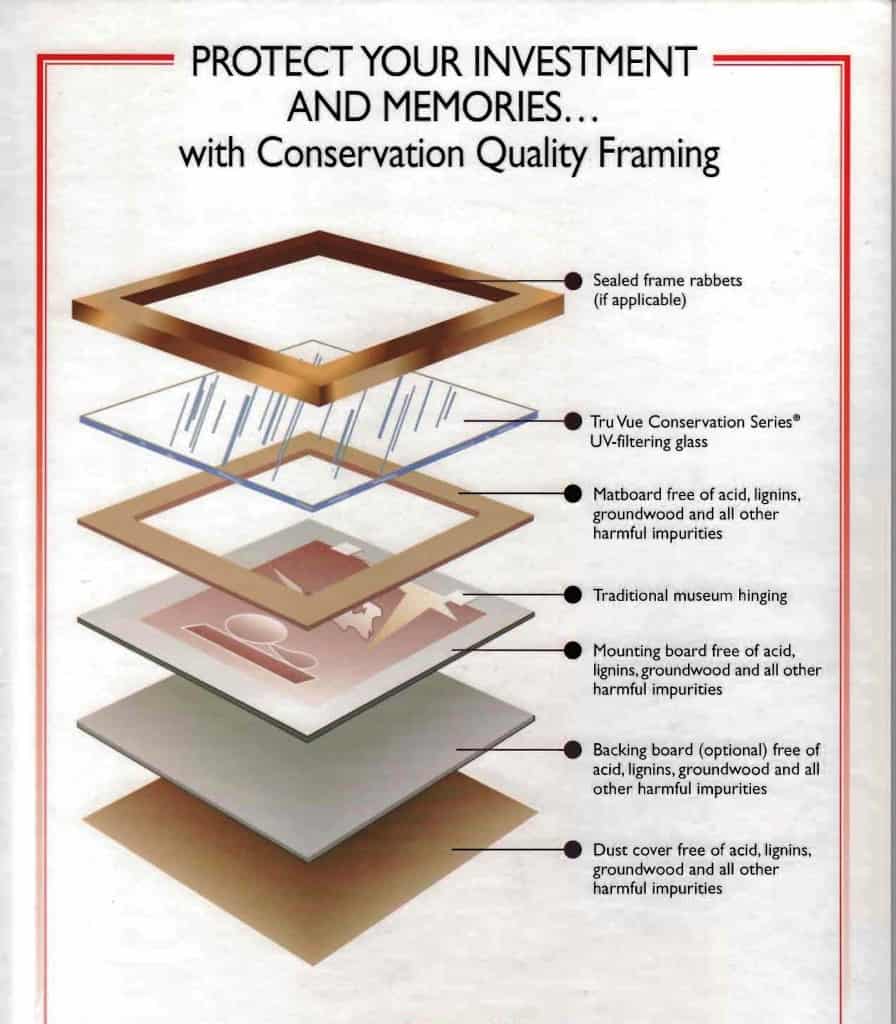
The framing of a work of art may involve making a choice between re-using an existing frame and selecting a new one. Illustration 1 shows a frame package in cross-section with the individual elements of the frame package identified. Whether an old or new frame, the following considerations apply:
- The rabbet should be deep enough to hold the glass, thick window mount or fillets, object, thick undermount and backboard.
- The molding must be both strong enough and deep enough to support the whole package. An old frame will sometimes need to be modified to meet these criteria.
Re-using old frames
If an old frame is to be re-used, it should be carefully cleaned and repaired, preserving all inscriptions and framing labels. The frame, mount, and glass may be of historical significance. Old decorative mounts such as Victorian gilt mounts can sometimes be re-used with an internal lining. Fixings need to be secured and weakened cord or wire should be replaced.
The conservation mount
The conservation mount comprises a window mount and undermount (sometimes also referred to as a back mount). To provide adequate physical and environmental protection both boards should be at least 1.3 millimeters thick, (4-6 sheet). The boards should be hinged along one edge using either a conservation gummed white paper tape or linen tape, (never pressure sensitive tapes).
The Mount
Because the picture is in direct contact with the mount, the choice of mount board is crucial to protecting framed works of art on paper. As a guide, there are three main categories of mount board and framing.
Museum level
For framing valued original works on paper
-
- Cotton museum mount board
This is usually solid core, made from 100% cotton fiber – a traditional paper making material, proven stable over hundreds of years. It can be un-buffered (neutral pH) or buffered with an alkali deposit which prolongs the stability of the board and provides some extra protection.
- Cotton museum mount board
Conservation Level
For framing original works on paper
-
- Conservation mount board
This refers to a board made from chemically purified wood pulp and then alkaline buffered. Like Cotton Museum board, the core and facings must meet certain criteria such as light fastness, pH ranges and quality of lamination adhesives.
- Conservation mount board
Mounting photographs
-
- photographs are a special case because some types may be affected by alkalinity: they should not, therefore, come into contact with an alkaline buffered board.
A pure, unbuffered cotton museum board is now commercially available.
- photographs are a special case because some types may be affected by alkalinity: they should not, therefore, come into contact with an alkaline buffered board.
Standard level
Not recommended for conservation framing
-
- Standard mount board
This is made from unpurified wood pulp. Unpurified wood pulp will gradually break down and release acidity, thereby damaging the picture. Although many wood pulp boards are now buffered with alkali and described as ‘acid-free’, this is misleading and is no longer a viable marketing term for any mount board.
- Standard mount board
The hinges
Paper is sensitive to its surroundings: it can be adversely affected by damp, changes in temperature and humidity, restriction of movement and exposure to light. Paper will also react to the materials with which it is in contact such as acidic support boards and self-adhesive tapes. Evidence of damage caused by adverse conditions can be seen in pictures with mount burns, foxing (small brown spots), fading of pigments or darkening and increasing brittleness of the paper.
Glazing
Works on paper need to be mounted clearly away from the glass to allow for air circulation and movement. Pastels and chalk drawings should be held at least 5-6mm from the glass, using either double or triple mounts. If the picture is to be ‘close framed’ (without a window mount) it should be held away from the glass with a small slip, card or fillets (4-6mm deep) tucked under the rabbet. There is a range of glazing materials with different optical properties. Where appropriate historic glass should be reused.
Reducing light exposure
- Museum level framing must use UV filtering glass and it should be strongly considered for conservation level. Light exposure has a pronounced effect on paper condition and pigments.
- The harmful effects of light can be reduced by using ultraviolet filtering glass or UVA Acrylics. Ideally, the glass should have the least amount of radiation below 400nm (invisible UV radiation) and the maximum amount of visible light transmission.
- PerspexTM and PlexiglassTM can be useful because they are lighter and unlikely to break on impact. However, these materials do scratch more easily and because of static, they should never be used to glaze pastels, chalks or any other friable materials.
- The mounted picture/glass sandwich can be sealed around the edges with gummed paper to prevent thunder flies or pollution from penetrating the frame.
The backboard and final assembly
- The backboard should be made of a stable, rigid material, such as pH neutral conservation backing board.
- Further protection from migrating acidity can be provided by the insertion of a sheet of MelinexTM (polyester film) or cooking foil between the back mount and backboard.
- It should be secured to the frame with sufficient non-rusting nails or fixings.
- The air gap should be sealed with a good quality gummed paper tape only. Pressure sensitive tapes fail and leave a sticky residue.
The fittings for hanging
- All hanging fittings should be strong and secure. The tension of the cord or wire should be checked to ensure that there is no strain on the frame when it is hanging.
- Riveted D-rings which go into the backboard should be avoided: they may cause pressure against the art or admit dust if not well sealed.
- Screw-eyes, hanging plates or rings should be attached to the frame itself and must be of sufficient strength to carry the weight involved.
© Icon, the Institute of Conservation 2011.